

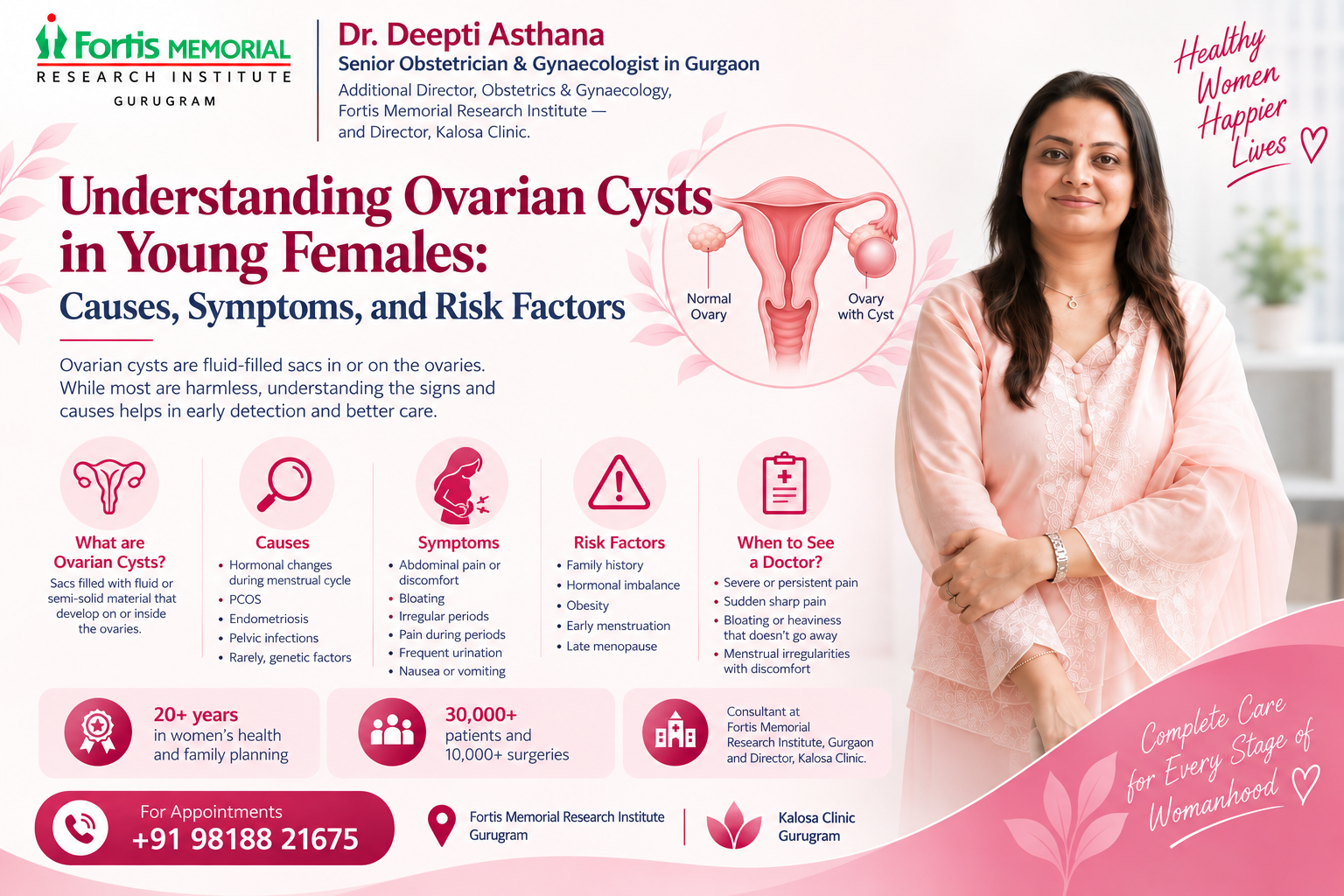
Ovarian cysts are fluid-filled sacs and small in size that form in the ovaries or on the ovaries. And this affects a young woman’s reproductive years. In many cases, cysts are harmless and can resolve without any major treatment, but can cause some inconvenience like pain, irregular periods, and complications that require medical care.
Young ladies fear that they will affect their lives. But the good thing is the majority of ovarian cysts are tiny, non-threatening and tend to resolve on their own. This comprehensive guide will provide all the information you require. We will describe what ovarian cysts are, reasons for their development, symptoms, and treatment options.
Dr. Deepti Asthana is senior gynecologist and additional director of the obstetrics and gynecology department at Fortis, Gurgaon. What causes ovarian cyst in unmarried girl is treatable or not, and requires a consultation with a senior gynecologist near you. In this blog, you’ll get to know about ovarian cysts and common questions about ovarian cysts and its treatment.
What is an Ovarian Cysts?
Ovarian cysts are fluid-filled sacs that develop either in or on the surface of an ovary. Women have two ovaries. Each ovary is located on either side of the uterus. The ovaries are almond-shaped organs. Ovaries have two primary functions: They store and release eggs monthly during your menstrual period.
- They make essential hormones such as estrogen and progesterone.
- Ovarian cysts are usually small. Some may be the same size as a pea or cherry. Their diameter is usually measured at about 1 to 3 cm.
Most ovarian cysts develop in the course of the regular monthly cycle. They are called functional cysts and are harmless. They disappear after a few weeks.
Types of Ovarian Cysts: Functional vs. Complex
Ovarian Cysts are not all alike. Knowing which ovarian cyst you have can help you understand what to anticipate.
1. Functional Cysts:
These are the most prevalent ovarian cysts found in young women. Functional cysts arise from your monthly menstrual cycle. There are basically two kinds of functional cysts:
Follicular Cysts: Each month, an egg develops inside a small sac known as a follicle. Usually, the sac ruptures and the egg gets released. However, in case the sac does not rupture, it fills up with fluid and becomes a cyst.
Corpus Luteum Cysts: after releasing the egg, the follicle shrinks. It then shrinks as part of the normal cycle. If it closes and fluid builds up inside, a corpus luteum cyst can form.. These cysts usually disappear on their own. Do not require any treatment.
2. Complex (Pathological) Cysts:
The development of these cysts is not dependent on your menstrual cycle; they develop from different tissues within the ovaries. Common types of complex cysts include:
Dermoid Cysts: They arise from cells that are already present from birth. They may contain hair, skin, or fatty tissues. Generally, they are non-cancerous.
Endometriosis: This develops due to the growth of uterine-type tissues in the ovaries, and they are filled with dark or old blood and are referred to as “chocolate cysts.”
Cystadenomas: These cysts form on the outside of the ovary. They have watery liquid or mucus in them.
A complex cyst will not dissolve by itself. They are monitored by doctors with scans or are removed if they become too big.
Functional vs. Complex Cysts: A Quick Comparison
| Feature | Functional Cysts | Complex Cysts |
|---|---|---|
| Origin | Linked to your monthly period | Not linked to your cycle |
| Common Types | Follicular, corpus luteum | Dermoid, endometrioma, cystadenoma |
| Disappears Alone? | Yes, usually in 1 to 3 months | No, they may stay or grow |
| Common Symptoms | Often none, or a mild dull ache | Persistent pain, pressure, or heavy bleeding |
| Treatment | Rest and simple monitoring | Scans, birth control, or surgery |
What Causes Ovarian Cysts in Unmarried Girls?
Here are some of the most common reasons why ovarian cysts occur in young women or unmarried girls.
1. Natural Hormonal Shifts
There will be fluctuations in your hormones during your menstrual cycle. In case your hormones fluctuate a little bit, then the egg sac might fail to rupture. This happens mostly in young girls who have just started their period cycle.
2. Irregular Menstrual Cycles
Irregular periods mean ovulation does not happen on a fixed schedule. This raises the chance of fluid backing up in an egg sac.
3. Endometriosis
Women with endometriosis often get endometriomas. The tissue grows on the ovary and bleeds during each period, creating a cyst over time.
4. Severe Pelvic Infections
A bad pelvic infection can spread to the ovaries. This can trigger inflammation and cause cysts or fluid pockets to form.
5. Past Ovarian Cysts
If you have had a cyst before, your body is more likely to form another one in the future.
Cyst in Ovary Symptoms:
Many cysts do not cause any symptoms. You may only discover one during a regular checkup or an ultrasound for another health issue. However, larger cysts can trigger noticeable signs.
- A dull or sharp ache in your lower stomach on one side
- A feeling of fullness, bloating, or heavy pressure in your belly
- Painful or irregular periods
- Spotting or light bleeding between your periods
- Pain during sexual intercourse
- Constant pressure on your bladder, causing frequent bathroom trips
- Difficulty or pain during bowel movements.
Most ovarian cysts are benign. However, certain complications may arise rapidly. Here are the symptoms to watch out for and head to the emergency room if you experience:
- Sudden and severe abdominal pain
- Pain accompanied by fever or vomiting
- Dizziness, weakness, or feeling faint
- Cold, clammy skin with rapid breathing
These warning signs usually point to one of two serious emergencies:
1. Ovarian Torsion: The presence of a large cyst can increase the weight of the ovary. This results in twisting of the ovary from its suspensory ligaments. The twisting cuts off the blood supply to the ovary. It leads to severe pain that requires immediate medical attention.
2. Cyst Rupture: A big cyst can rupture at times. When this occurs, either fluids or blood can leak into the abdominal cavity. This leads to sharp pains. It may even cause internal bleeding.
How Do Dr. Deepti Asthana Check for Ovarian Cysts?
In case you have any cyst in ovary symptoms and looking for Ovarian Cyst Treatment in Gurgaon your physician may carry out several basic tests to identify the condition of your ovaries and the type of the cyst.
- Pelvic Ultrasound: Pelvic ultrasound is one of the tests done when checking on ovarian cysts. The test works through sound waves, which produce pictures of the ovaries. The test helps detect the size, location, and form of the cysts. It detects whether the cysts are simple (containing only fluids) or complex (having solid tissue).
- Blood Tests for Hormones: A doctor can measure your hormones to determine whether there is a hormonal imbalance.
- Pregnancy Test: Pregnancy tests will help to rule out ectopic pregnancy. An ectopic pregnancy may cause lower abdominal pain.
How Doctors Treat Ovarian Cysts in Unmarried Girls?
Treatment depends on your age, your symptoms, and the type and size of the cyst.
- Watchful Waiting: This is the most common approach for small, simple cysts. Your doctor will ask you to wait 1 to 3 months. Then, they will do another ultrasound. In most cases, the cyst shrinks and disappears on its own.
- Medication: Your doctor might prescribe birth control pills. Hormone pills do not shrink an existing cyst. They will, however, prevent ovulation so that no more cysts develop in the coming menstrual cycles.
- Surgery: Surgery is rare for young females. Surgical intervention is necessary in cases where:
- The size of the cyst exceeds 5-7 cm.
- The cyst causes severe or persistent pain.
- The ultrasound image indicates that it is complex and solid.
- The condition persists for several months.
- The danger of ovary twisting and rupture exists.
When the surgery becomes necessary, surgeons may opt for laparoscopic surgery. This is a less invasive technique wherein the surgeon makes an incision in the belly button area. They insert a camera and surgical instruments through the incision. This will result in less scarring and quicker recovery.
Home Care and Relief Tips:
While your cyst heals, you can take care of your pain at home.
- Put a heating pad to your lower abdomen area. It can relieve any cramping.
- You can try ibuprofen or acetaminophen for the pain, but consult your physician first.
- Consume enough water throughout the day. This can be helpful for bloating and digestion.
- If you have a large cyst, you should avoid strenuous physical activity to decrease the risk of torsion.
- You can drink warm chamomile or ginger tea that can relieve any cramping.
When to see your doctor :
Visit your doctor if you experience any pain or change in your menstrual cycle. The following conditions warrant a visit:
- Pain in the lower abdomen
- Excessive, scanty, or irregular periods
- Bloating that doesn’t seem to go away
- Feeling full more often than usual
A visit will help determine the cause of your problem. Your doctor can also guide you on what to do next.
Common Myths: Debunking What You've Heard
Misinformation causes unnecessary fear. Let’s clear up two big myths about ovarian cysts.
Myth 1: “Only married or sexually active women get cysts.”
Fact: Cysts form because of your natural hormones and periods. Marital status and sexual activity have nothing to do with them. Teenagers and young unmarried women get cysts all the time.
Myth 2: “An ovarian cyst means you are infertile.”
Fact: Most functional cysts go away on their own. They usually do not harm the ovaries or affect your ability to have children later.
EXCELLENTTrustindex verifies that the original source of the review is Google. I had a wonderful experience with Dr. Deepti Asthana throughout my pregnancy. She was extremely supportive, patient, and approachable at every step. She always listened to my concerns carefully and explained everything clearly, which gave me a lot of confidence and peace of mind. I truly appreciate the care, guidance, and personal attention I received throughout my pregnancy and delivery. I felt completely comfortable and well taken care of under her supervision. I would highly recommend her to anyone looking for a knowledgeable, compassionate, and trustworthy gynaecologist. Thank you so much, Doctor Deepti Asthana, for being such an important part of this beautiful journey!Posted on GoogleTrustindex verifies that the original source of the review is Google. I have been consulting Dr. Deepti since the past 3 years. Starting as my gynaecologist, treating my PMOS to guiding me into motherhood and finally, being my Obstetrician to deliver my twin babies via C-section. She have been an unwavering support throughout the journey, and all this couldn't have been possible without her. She has a very professional, knowledgeable, non-judgmental and empathetic approach towards all her patients, and makes you feel comfortable and heard. I can definitely recommend her to others with my eyes closed.Posted on GoogleTrustindex verifies that the original source of the review is Google. Dr Deepti Asthana is a wonderful doctor and I feel really fortunate to have found her. She has a pleasant, positive and reassuring manner. She listened to my concerns as a patient and factored them in her treatment plan. My surgery went off seamlessly and the recovery is also very good. Her coordinator Rhea was also very helpful.Posted on GoogleTrustindex verifies that the original source of the review is Google. Dr. Deepti is an absolute blessing! What stands out most about her—besides her incredible expertise—is her unmatched patience and dedication. No matter when I reached out, she was always available to guide and support me, responding promptly and offering reassurance at every step. She listens attentively to every concern and never makes you feel rushed. Having a doctor who is both exceptionally skilled and so reliably accessible gives immense peace of mind.Posted on GoogleTrustindex verifies that the original source of the review is Google. I have been consulting Dr. Deepti Asthana for the last 2.5 years, and I am truly grateful to have found such a wonderful doctor. From my two surgeries, including my endometriotic cyst surgery, to my entire pregnancy journey and finally bringing my baby safely into this world, she supported me at every step. She always takes the time to explain everything clearly and patiently, which gave me a lot of confidence and peace of mind. She is very humble, caring, and trustworthy. Thank you, Dr. Deepti, for all your care, guidance, and support throughout my journey. A special thank you for safely bringing my baby into this world. I will always be grateful for everything. I highly recommend Dr. Deepti Asthana to anyone looking for a caring and experienced gynaecologist 🫰🏼🫰🏼Posted on GoogleTrustindex verifies that the original source of the review is Google. I am extremely grateful to Dr. Deepti Asthana for her outstanding care and support throughout my high-risk pregnancy. From the very beginning, she closely monitored my condition and guided me with confidence, professionalism, and compassion. Her clear explanations, timely advice, and reassuring approach helped ease my anxiety and made me feel safe throughout the journey. What I appreciated most was her patience in addressing all my concerns and her genuine commitment to both my health and my baby's well-being. Thanks to her expertise and dedicated care, I had a positive pregnancy experience despite the challenges. I highly recommend Dr. Deepti Asthana to anyone looking for a skilled, caring, and trustworthy gynecologist.🌸Posted on GoogleTrustindex verifies that the original source of the review is Google. Special thanks to dr Deepti mam and her team …. Iam writing this to express my deepest gratitude for the care and treatment you provided ……….. Thank you for guiding me through one of the scariest moments of my life.. your confidence gave me strength ,and your care helped me heal faster than I imagined Once again thank you soo much mam ❤️🫰🏻Posted on GoogleTrustindex verifies that the original source of the review is Google. Dr Deepti Asthana is best when it comes to take care of her patients. She is always available, active and passionate about caring. We are thankful to her. 🙏🏽Verified by TrustindexTrustindex verified badge is the Universal Symbol of Trust. Only the greatest companies can get the verified badge who has a review score above 4.5, based on customer reviews over the past 12 months. Read more
FAQs
1. What Are the Initial Symptoms of Ovarian Cysts?
Ovarian cysts rarely have any symptoms associated with them. In case you experience any symptoms, they include:
- Pelvic pain
- Persistent bloating
- Pain during intercourse
- Abdominal pain
2. Where does ovarian cyst pain occur?
Pain occurs generally in the lower abdomen, below the navel, either on the left or right side, depending on where the ovarian cyst occurs. Pain can also extend to the lower back and the thighs.
3. How will I know if my ovarian cyst is ruptured?
The symptoms of a ruptured cyst include sudden sharp pains in the lower abdomen region. Other symptoms include feeling faint or weak. Women might experience light bleeding from the vagina.
4. Does an ovarian cyst resolve by itself?
Yes, because most of these cysts are called "functional cysts," which appear due to the menstrual cycle, and are completely harmless. They will resolve themselves without any need for medical intervention within a period of 1 to 3 months.
5. Will an ovarian cyst affect my ability to get pregnant?
No, in most cases. Functional cysts are generally benign and do not harm your ovaries or result in infertility. If a cyst requires surgery, the doctor takes great care to preserve your ovary for future conception.
6. Can an ovarian cyst become cancerous?
In younger women, most ovarian cysts are benign and not cancerous. Ovarian cancer rarely occurs in younger women but is relatively common after menopause.
7. Will birth control pills reduce the size of cysts?
Birth control pills will not reduce the size of the cyst or cause it to dissolve. However, it prevents ovulation and reduces the chances of developing new functional cysts.
8. How big an ovarian cyst should be to require surgery?
Small cysts are usually monitored by ultrasound tests. Surgery may be required when a cyst is more than 5 to 7 cm. It might also be required when the cyst persists for a few months, is accompanied by severe pain, and has a complex appearance under imaging.
9. Can teenagers or unmarried girls have an ovarian cyst?
Yes, ovarian cysts may appear at any age following menstruation onset. They occur due to changes in hormones during the menstrual cycle and are unrelated to sexual intercourse and marriage.
10. How does PCOS differ from an ovarian cyst?
An ovarian cyst is usually a single sac with fluid inside. It can go away on its own. PCOS is a hormone-related disorder that may result in irregular menstruation, acne, and other signs. PCOS could also have multiple ovarian follicles.
Written and Verified by:

Dr. Deepti Asthana
Dr. Deepti Asthana is a leading gynecologist and laparoscopic surgeon in Gurgaon, Delhi NCR, backed by over 20 years of clinical excellence. Having treated more than 30,000 patients and successfully performed over 10,000 complex gynecological surgeries.
She is widely trusted for comprehensive women's healthcare. Dr. Deepti Asthana specializes in managing all major female health conditions, ranging from normal deliveries and high-risk Caesarean births to advanced minimally invasive procedures such as laparoscopic hysterectomy, laparoscopic endometriosis surgery, ovarian cyst removal, and uterine fibroid treatment.
Her patient-first philosophy, individualized treatment protocols, and expertise in modern surgical techniques make her a top choice Best Gynecologist in Gurgaon.


