

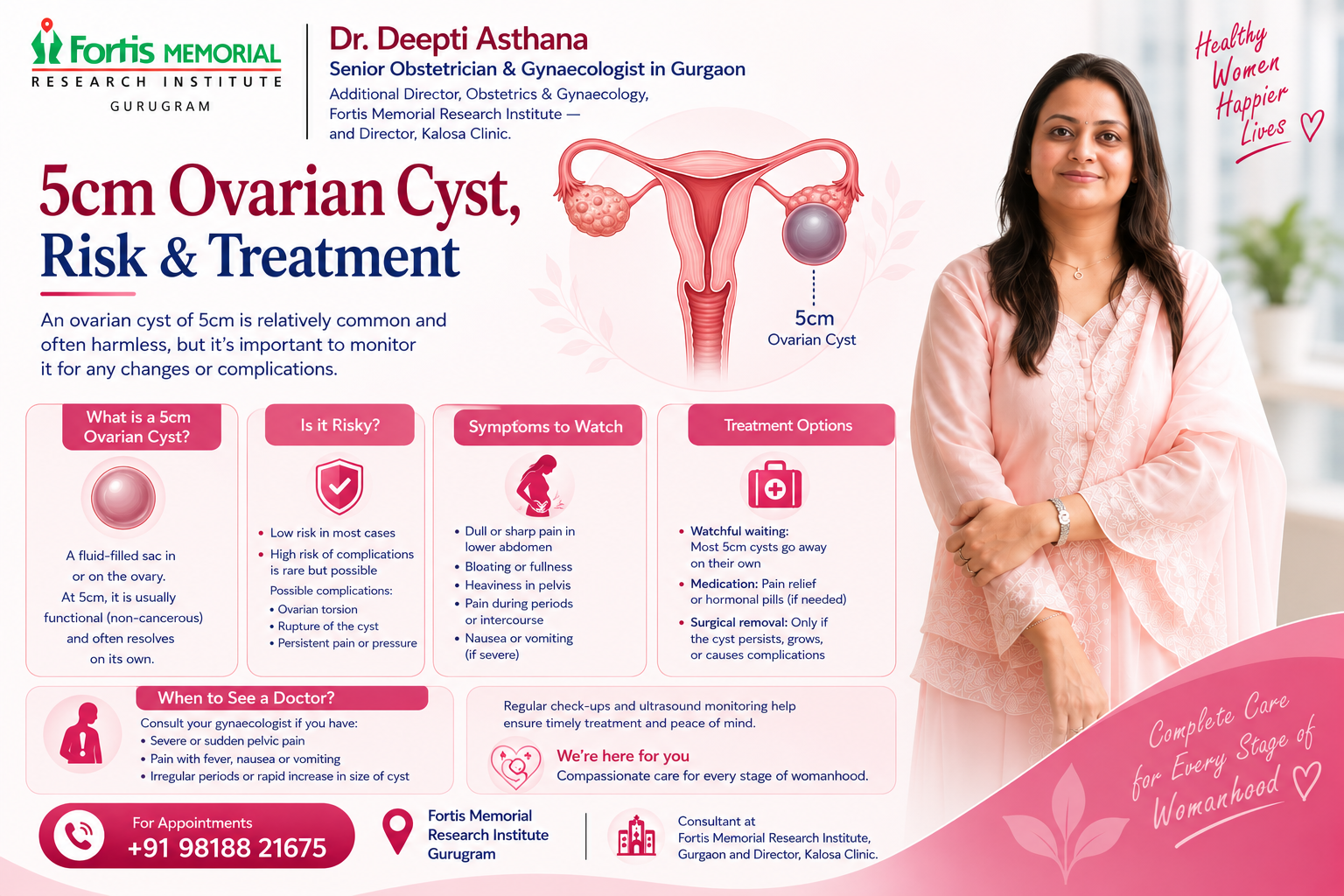
Finding out that you have a 5 cm ovarian cyst can lead to many questions. Is it dangerous? Can it disappear by itself? Will surgery be required, and will it have any effect on your ability to conceive?
A 5 cm ovarian cyst is a fluid-filled growth about 5 centimeter or 50mm in size located on or inside the ovary. Sometimes, ovarian cysts go away on their own, and sometimes they require close observation or surgical intervention. However, the best method of 5cm ovarian cyst treatment will be determined by the type of cyst, appearance, symptoms as well as general health of the patient. By understanding various treatment methods available for the 5cm ovarian cyst, the patient will be able to consult their gynecologist and take a correct course of action.
Dr. Deepti Asthana is senior gynecologist and additional director of the obstetrics and gynecology department at Fortis, Gurgaon. 5cm ovarian cyst is treatable or not, and requires a consultation with a senior gynecologist near you. She is best ovarian cyst treatment doctor in Gurgaon. In this blog, you’ll get to know about ovarian cyst normal size and common questions about 5cm ovarian cysts and its treatment.
What Are the Types of 5 cm Ovarian Cyst Treatment?
There are two major methods for treating a 5 cm ovarian cyst. Your gynecologist will suggest the appropriate one based on your test reports and symptoms.
1. Watchful Waiting: Watchful waiting involves observing the ovarian cyst but not performing surgical intervention straight away. In your case, you will be scheduled to have ultrasound scans at various intervals over the next few weeks or months to determine whether the ovarian cyst is shrinking or growing. This procedure may be recommended if the cyst is simple and asymptomatic with favorable scan results. Functional cysts may just go away in a few menstrual cycles. It is critical to have follow-up consultations in case there is a cyst that is growing, persisting or developing certain characteristics.
2. Surgical Operation: In case the ovarian cyst persists in its growth, causes constant pain, seems complicated after ultrasound scan or is suspected to be cancer. Your gynecologist might advise you to undergo a surgical operation. The type of the surgery will vary depending on the ovarian cyst’s size, location and appearance. Two types of surgery for 5cm ovarian cyst problem include:
2.1 Laparoscopy: Laparoscopy is a minimally invasive surgical operation used most often for the removal of benign ovarian cysts. The surgeon makes some incisions in the abdomen and then introduces a slender device with a camera for examining the pelvic organs. Then special surgical tools are used for ovarian cyst removal. Unlike open surgery, laparoscopy is characterized by lower postoperative pain and quicker healing time.
2.2. Laparotomy: Laparotomy is an open surgical operation performed via a bigger incision in the abdomen. It can be necessary if the ovarian cyst is quite big or its characteristics suggest cancer. The surgeon can gain direct access to the ovarian cyst and decide whether only the cyst itself or some additional tissue should be removed. The determination is based on the results and the particular condition of the patient.
Treatment for 5 cm Ovarian Cyst:
5 cm ovarian cyst treatment depends on if the cyst is simple or complex; the presence or absence of symptoms; and if there has been any change in the size of the ovarian cyst over the period of observation. Your doctor might ask you to go for ultrasound scans or advise surgery depending upon your condition.
A simple cyst that does not have any symptoms can be managed through observation. However, a complex cyst, dermoid, or hemorrhagic cyst might need more testing. Your age, period cycle, whether you are menopausal or are planning to conceive will be important in making recommendations. When surgery becomes the only method, the two common procedures performed are laparoscopy and laparotomy.
1. Laparoscopy is done through small incisions in the abdomen and offers fast healing.
2. Laparotomy involves a large cut especially for big cysts or cancer. The main aims of therapy include the alleviation of the symptoms, the prevention of the complications, and maintenance of the ovarian function where it is possible.
Diagnosis before the 5 cm Ovarian Cyst Treatment:
Before starting 5cm ovarian cyst treatment, your doctor has to determine the size, structure, and possible origin of the ovarian cyst. A number of tests can assist in making a diagnosis.
- Pelvic examination: The gynecologist might conduct a pelvic examination to detect any tenderness, swelling, etc.
- Ultrasound scan: A pelvic ultrasound, including a transvaginal ultrasound when appropriate, helps identify the cyst’s size, location and appearance. It can show whether the cyst is mainly fluid-filled or contains solid areas.
- Blood tests: A CA-125 blood test may be advised when the ultrasound findings, age or menopausal status raise concerns about ovarian cancer. This test cannot confirm cancer on its own because CA-125 can also increase in non-cancerous conditions.
- Further imaging or investigations: An MRI or other tests may be required if the ultrasound does not provide enough information. Laparoscopy is a surgical procedure, not a routine first-line diagnostic test for every ovarian cyst, but it may be considered in selected cases.
Your doctor will assess the results together rather than relying on the cyst’s size alone. This helps determine whether monitoring, additional testing or surgery is appropriate.
Who is the Right Candidate for 5 cm Ovarian Cyst Treatment?
Ovarian Cyst Surgery is not required by all individuals diagnosed with a 5 cm ovarian cyst. There are a few key factors to consider.
- Size and type of ovarian cyst: A simple cyst can be followed up, whereas a complicated or enlarging cyst needs further investigation. A single measurement of 5 cm cannot be used to determine the necessity of surgery.
- Symptoms: Consistent pelvic pain, stomach pain, or bloating and pressure on surrounding organs may affect the treatment plan.
- Pregnancy: Ovarian cysts detected in pregnancy should be monitored in many cases. A cyst with a size of 5-6 cm could require follow-up ultrasound based on its presentation and symptoms. Surgery is recommended if there is clinical indication to do so.
- Menopausal status: Ovarian cysts after menopause need careful assessment because the risk of ovarian cancer increases with age. The ultrasound appearance, CA-125 result when indicated, and other clinical factors help guide management.
- Fertility plans: If you want to become pregnant in the future, discuss fertility preservation with your gynaecologist before surgery.
Your doctor will weigh these factors to decide whether the benefits of 5cm ovarian cyst treatment outweigh its risks.
Post-Treatment Care and Support:
Recovery requirements can differ based on whether you are under observation, laparoscopy, or open surgery. In case of 5cm ovarian cyst surgery, inquire about the support services that your hospital provides before and after the surgery. Post-treatment care may consist of:
- Diet and lifestyle guidance: Advice on eating well, staying hydrated and gradually returning to daily activities.
- Follow-up visits for recovery: Scheduling appointments to check on your healing process, discuss tests, and deal with any issues.
- Transportation assistance: Inquire about the transportation services offered by the hospital, especially if you need to travel after your operation.
- Patient counseling: Information on wound care, medication, restrictions on activities, and when to visit the doctor.
These facilities differ from one hospital to another, so make sure to check their availability when planning your treatment plan.
What Are the Benefits of 5 cm Ovarian Cyst Treatment?
The is beneficial in alleviating pain and handling other symptoms. This depends on the nature of the ovarian cyst.
- Relief from symptoms: Elimination of a cyst causing pain or pressure will alleviate discomfort in the patient’s day-to-day life.
- Reduced risk of complications: Proper treatment helps in minimizing complications like cyst rupture, etc.
- Fertility support: If surgical intervention is necessary, the excision of the cyst while leaving other parts of the ovary intact may contribute to the preservation of fertility. Nevertheless, the result will depend on the cyst and the method used.
- Further assessment of suspicious cysts: Removal of the cyst and analysis of the tissue under laboratory conditions can be helpful to determine the nature of the cyst if there is a possibility of cancer.
The benefits do not suggest that every cyst has to be treated surgically. Sometimes monitoring may be a safer approach for certain individuals.
How to Prepare for 5 cm Ovarian Cyst Treatment?
Knowing about your treatment can help you prepare for recovery.
- Discuss fertility concerns: Let your doctor know if you intend to get pregnant in the future. Ask if the cyst can be removed without damaging the ovaries.
- Observe the preoperative instructions: If surgery is scheduled, follow the hospital guidelines concerning fasting, medications, and the necessary tests. Don’t discontinue any prescribed medications without consultation.
- Arrange support: If necessary, ask a relative or a friend to assist you with transport or other household duties following surgery.
- Understand the procedure: Inquire about the surgical process, the type of anesthesia, hospital stay, risks involved, and the recovery period.
- Share your medical history: Notify the surgeon about your current health problems, any allergies, past surgeries, and all the medications you take.
If further monitoring is advised without undergoing an operation, make sure to be aware about when you have to come back for your check-up.
What Are the Recovery Tips and Precautions to Follow After 5 cm Ovarian Cyst Surgery?
These are some easy tips you can follow after ovarian cyst removal surgery to ensure speedy recovery and avoid any complications.
- Take your medicines: Use the medicines your doctor prescribes.
- Ask before taking any extra painkillers.
- Get enough rest, give your body time to heal. Return to work and daily tasks slowly.
- Keep the wound clean follow your hospital’s guidelines regarding bathing and injury care.
- Avoid lifting any heavy objects or doing any physical activity until your doctor gives you the go-ahead.
- Keep follow-up visits, your physician will monitor your healing process and lab results. So, never skip follow up. They will also tell you when you can return to normal activities.
- Look out for abnormal things, consult your doctor immediately if you have fever, excessive bleeding, increasing pain, swelling and foul-smelling discharge.
- Seek immediate medical attention if you experience sudden, intense pain in your lower abdomen or pelvic area, particularly if accompanied by vomiting, dizziness, or fainting.
These symptoms could be indicative of a serious condition, such as ovarian torsion or cyst rupture.
Potential Risks or Complications
Ovarian cyst removal surgery is normally done for a certain medical issue, but, like any other surgery, it does pose some risks. These will be explained by your doctor based on your condition.
- Infection: There is a possibility that an infection may develop in the surgical incision or other body parts involved.
- Bleeding: A little bit of bleeding might be observed before or after the surgery, and further treatment might be required in rare situations.
- Adhesions: Adhesion may form within the abdominal or pelvic areas and may result in painful experiences and fertility problems in certain cases.
- Ovarian tissue injury: There might be damage to a part of the ovarian tissue during the removal of the cysts.
- Anaesthesia-related complications: It is possible for certain individuals to develop nausea or other reactions associated with anaesthesia. Serious complications are less common.
- Need for further treatment: If the lab test results reveal any suspicious growth, then additional surgery may be needed. It is also possible that some cysts may reoccur.
Also, the discussion regarding the removal of the ovary needs to be done prior to surgery because in some cases, this is necessary for safety reasons. However, surgeon generally try to retain ovarian function whenever possible.
What Is the Cost of 5 cm Ovarian Cyst Treatment in India?
The cost incurred to treat a 5 cm ovarian cyst in India will depend on the kind of treatment needed. The monitoring of a simple cyst is expected to cost much lower compared to the cost of surgery. The final expense can depend on the following factors:
- Doctor’s fees: Fees for consultations and expertise of the surgeon can affect the overall cost.
- Hospital and location: Cost will vary depending on the hospital and the city from which the treatment is received.
- Diagnostic tests: Ultrasound tests, blood tests, and MRIs, wherever applicable, will also contribute to the cost.
- Surgical Procedure: Both laparoscopic and laparotomy surgical procedures involve different hospital and surgical needs.
- Medicines and recovery care: The drugs, anaesthesia, hospital stay, post-op appointments and further treatments can influence the total cost.
A cyst measuring 5 cm is not necessarily indicative of the need for surgery, so it is better to get a quotation of the cost after the doctor has examined the results and decided on a course of treatment. Get a detailed quotation from the hospital covering consultations, examinations, surgical procedures if necessary, hospitalization, cost of medication, etc.
Is 5 cm Ovarian Cyst Treatment Covered Under Insurance?
In many cases, health insurance covers medically required treatment for ovarian cysts, including any hospital admission and surgical treatment, based on the conditions stipulated in the insurance policy. Before undergoing any treatment, you should first verify the following:
- Waiting periods: A policy may have a waiting period for pre-existing conditions or specified treatments.
- Policy exclusions: Certain procedures, costs, or types of treatment may be excluded from the policy.
Coverage limits: Room-rent limits, sub-limits, deductibles or co-payments can affect the amount payable by the insurer. - Network hospitals: Make sure that your preferred hospital is part of the insurance company’s network hospitals for cashless treatment facilities.
- Required documents: The insurance company might ask for all medical certificates, reports of ultrasounds, medical prescription for surgery, and recommendation of the doctor.
The coverage of the procedure varies from a simple cyst to a dermoid or haemorrhagic cyst, depending on the individual’s situation medically and insurance terms. Talk to your insurance company before undergoing any procedures to ensure you have proper coverage for the situation.
Get Medical Advice for a 5 cm Ovarian Cyst:
A 5 cm ovarian cyst does not always mean you need surgery. The right treatment starts with understanding the cyst’s type, appearance and effect on your health. Consult a qualified gynaecologist to review your ultrasound findings, discuss your symptoms and decide whether monitoring or surgery is appropriate. Seek urgent medical care for ovarian cyst treatment in Gurgaon if you have sudden, severe pelvic pain.
EXCELLENTTrustindex verifies that the original source of the review is Google. I had a wonderful experience with Dr. Deepti Asthana throughout my pregnancy. She was extremely supportive, patient, and approachable at every step. She always listened to my concerns carefully and explained everything clearly, which gave me a lot of confidence and peace of mind. I truly appreciate the care, guidance, and personal attention I received throughout my pregnancy and delivery. I felt completely comfortable and well taken care of under her supervision. I would highly recommend her to anyone looking for a knowledgeable, compassionate, and trustworthy gynaecologist. Thank you so much, Doctor Deepti Asthana, for being such an important part of this beautiful journey!Posted on GoogleTrustindex verifies that the original source of the review is Google. I have been consulting Dr. Deepti since the past 3 years. Starting as my gynaecologist, treating my PMOS to guiding me into motherhood and finally, being my Obstetrician to deliver my twin babies via C-section. She have been an unwavering support throughout the journey, and all this couldn't have been possible without her. She has a very professional, knowledgeable, non-judgmental and empathetic approach towards all her patients, and makes you feel comfortable and heard. I can definitely recommend her to others with my eyes closed.Posted on GoogleTrustindex verifies that the original source of the review is Google. Dr Deepti Asthana is a wonderful doctor and I feel really fortunate to have found her. She has a pleasant, positive and reassuring manner. She listened to my concerns as a patient and factored them in her treatment plan. My surgery went off seamlessly and the recovery is also very good. Her coordinator Rhea was also very helpful.Posted on GoogleTrustindex verifies that the original source of the review is Google. Dr. Deepti is an absolute blessing! What stands out most about her—besides her incredible expertise—is her unmatched patience and dedication. No matter when I reached out, she was always available to guide and support me, responding promptly and offering reassurance at every step. She listens attentively to every concern and never makes you feel rushed. Having a doctor who is both exceptionally skilled and so reliably accessible gives immense peace of mind.Posted on GoogleTrustindex verifies that the original source of the review is Google. I have been consulting Dr. Deepti Asthana for the last 2.5 years, and I am truly grateful to have found such a wonderful doctor. From my two surgeries, including my endometriotic cyst surgery, to my entire pregnancy journey and finally bringing my baby safely into this world, she supported me at every step. She always takes the time to explain everything clearly and patiently, which gave me a lot of confidence and peace of mind. She is very humble, caring, and trustworthy. Thank you, Dr. Deepti, for all your care, guidance, and support throughout my journey. A special thank you for safely bringing my baby into this world. I will always be grateful for everything. I highly recommend Dr. Deepti Asthana to anyone looking for a caring and experienced gynaecologist 🫰🏼🫰🏼Posted on GoogleTrustindex verifies that the original source of the review is Google. I am extremely grateful to Dr. Deepti Asthana for her outstanding care and support throughout my high-risk pregnancy. From the very beginning, she closely monitored my condition and guided me with confidence, professionalism, and compassion. Her clear explanations, timely advice, and reassuring approach helped ease my anxiety and made me feel safe throughout the journey. What I appreciated most was her patience in addressing all my concerns and her genuine commitment to both my health and my baby's well-being. Thanks to her expertise and dedicated care, I had a positive pregnancy experience despite the challenges. I highly recommend Dr. Deepti Asthana to anyone looking for a skilled, caring, and trustworthy gynecologist.🌸Posted on GoogleTrustindex verifies that the original source of the review is Google. Special thanks to dr Deepti mam and her team …. Iam writing this to express my deepest gratitude for the care and treatment you provided ……….. Thank you for guiding me through one of the scariest moments of my life.. your confidence gave me strength ,and your care helped me heal faster than I imagined Once again thank you soo much mam ❤️🫰🏻Posted on GoogleTrustindex verifies that the original source of the review is Google. Dr Deepti Asthana is best when it comes to take care of her patients. She is always available, active and passionate about caring. We are thankful to her. 🙏🏽Verified by TrustindexTrustindex verified badge is the Universal Symbol of Trust. Only the greatest companies can get the verified badge who has a review score above 4.5, based on customer reviews over the past 12 months. Read more
FAQs
1. Is a 5 cm ovarian cyst dangerous?
Not always. Most 5cm ovarian cysts are non-cancerous and can be observed. However, further examination may be needed for those that cause prolonged pain, have become larger, are complicated and arise following menopause. The doctor will determine this based on symptoms and test findings.
2. Can a 5 cm ovarian cyst go away without treatment?
Yes, some functional ovarian cysts usually tend to heal spontaneously over several menstrual cycles. While other types of cysts, including dermoid cysts, usually do not go away on their own.
3. Does a 5 cm ovarian cyst always require surgery?
No, you do not necessarily have to undergo surgery for every cyst. Your doctor can advise for surveillance if the cyst appears to be simple and does not produce any symptoms. Surgery may be an option if the cyst does not go away, keeps growing, or is causing pain/discomfort.
4. Can a 5 cm ovarian cyst affect pregnancy?
Depending on the type of ovarian cyst and the underlying problem, some ovarian cysts may make it difficult for you to conceive. Most women who have ovarian cysts can get pregnant. You should talk to your gynecologist about fertility preservation prior to any surgical procedure.
5. How long does it take to recover from ovarian cyst surgery?
It all depends on the type of surgery you have undergone and your general state of health. Generally, recovery is much faster with laparoscopy than with open surgeries. However, the period required for resumption of normal activity differs.
6. What Is a 5 cm Complex Ovarian Cyst?
A complex ovarian cyst contains different components, such as fluid-filled areas and solid parts. Its treatment depends on its appearance, symptoms and ultrasound findings. Your gynaecologist may recommend further tests, regular monitoring or surgery if necessary.
7. Is Having a 5 cm Dermoid Cyst in the Ovary Considered Normal?
Dermoid cyst is most often a benign growth that contains certain kinds of tissues, including hair, skin, or fat. Since a 5 cm dermoid cyst might require medical assessment due to its specific nature and possible complications, your doctor can advise you what actions should be taken.
8. What Complications Can a 5 cm Haemorrhagic Ovarian Cyst Cause?
Haemorrhagic ovarian cyst occurs due to bleeding within the cyst. This can lead to pain in the pelvis and even rupturing of the cyst, which causes internal bleeding. Severe pain in the abdomen and pelvis, and even fainting calls for immediate medical attention.
9. Can a 5 cm Ovarian Cyst Be Treated Naturally?
Eating well and living a healthy life may keep you healthy overall, but they will not help to get rid of an ovarian cyst. Treatment depends on the cyst's type, size and symptoms. Consult a gynaecologist before trying home remedies or supplements, and follow the recommended monitoring or treatment plan.
Written and Verified by:

Dr. Deepti Asthana
Dr. Deepti Asthana is a leading gynecologist and laparoscopic surgeon in Gurgaon, Delhi NCR, backed by over 20 years of clinical excellence. Having treated more than 30,000 patients and successfully performed over 10,000 complex gynecological surgeries.
She is widely trusted for comprehensive women's healthcare. Dr. Deepti Asthana specializes in managing all major female health conditions, ranging from normal deliveries and high-risk Caesarean births to advanced minimally invasive procedures such as laparoscopic hysterectomy, laparoscopic endometriosis surgery, ovarian cyst removal, and uterine fibroid treatment.
Her patient-first philosophy, individualized treatment protocols, and expertise in modern surgical techniques make her a top choice Best Gynecologist in Gurgaon.


