

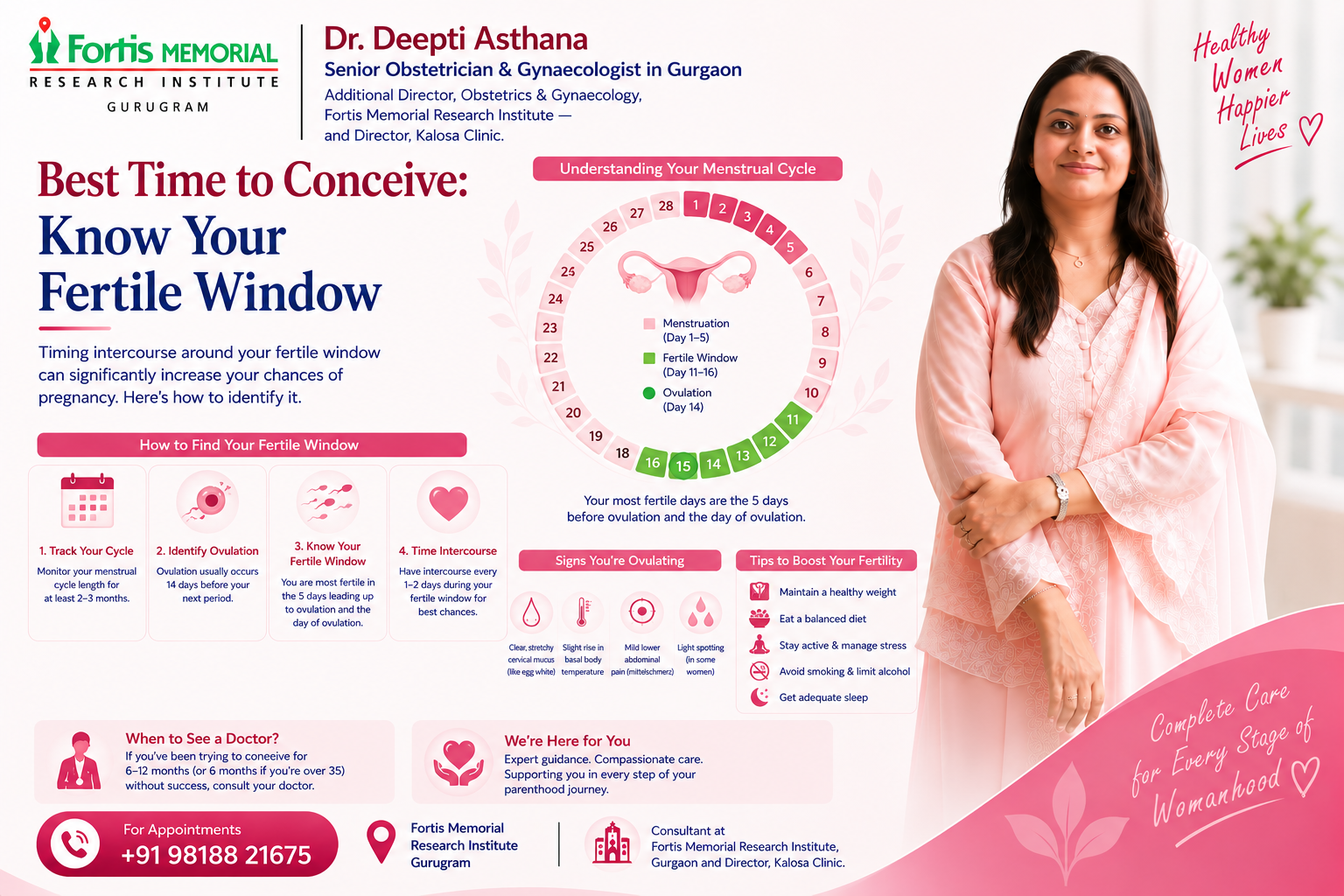
Planning a pregnancy is more than just stopping contraception. Once you know when you’re most fertile, you can better understand when you should or shouldn’t try for a baby. The time will vary primarily with ovulation, which is the time of release of an egg from an ovary.
If the sperm is present in the reproductive tract at the time of the egg’s release, the chances of pregnancy are highest. But not every woman or menstrual cycle is the same in terms of the day she ovulates.
Here you will find out how to figure out the dates of your fertile days, cycle, and boost your chances of conceiving.
When is the best time to conceive?
The best time to get pregnant is the five days prior to ovulation and the day of ovulation. Pregnancy is most likely to occur on the 2 days prior to ovulation.
This is because sperm are able to live for up to five days in the female reproductive system under favourable conditions. After ovulation, however, the egg is typically only available for fertilisation for around 12 to 24 hours.
Having sex before ovulation gives sperm a chance to reach the fallopian tube before the egg is released. If couples are attempting pregnancy without using fertility aids, they can enhance their chances of getting pregnant by having sex every one to two days during the fertile window.
How To Calculate Your Fertile Days?
One of the best ways to gauge your fertile days is to map out your cycle. But keep in mind that this is an estimate and not a prediction.
Understand Your Menstrual Cycle
The menstrual cycle starts on the 1st day of your period and stops on the day before your next period. Ovulation doesn’t always happen on the 14th day of the cycle, but generally happens 14 days before the next period. If you have a standard 28-day cycle, for instance, then you might ovulate around day 14. Your fertile window could be days 9-14. For those with a 32-day cycle, ovulation could happen around day 18. The fertile window can then be days 13-18. The dates may change. Women who have irregular periods may have trouble predicting their ovulation using just a calendar.
Track Period Dates
Record the first day of each period for a few months. Note the usual length of your cycles and any changes in your bleeding pattern. This information can be useful in determining an approximate time of ovulation. For irregular periods, an ovulation test or medical evaluation might be more helpful.
Signs That You May Be Ovulating
As you approach ovulation, your body may experience some changes. These are the signs that can help you identify your fertile days.
Cervical mucus change
The fluid made by the cervix is called cervical mucus. Ovulation is often accompanied by clear, slippery and stretchy (like the egg white) consistency.
This kind of mucus is beneficial for the movement of the sperm through the reproductive tract. When you observe this change you could be reaching your fertile window.
Positive Ovulation Test
A rise in luteinising hormone (LH) in the urine is detected with home ovulation predictor kits. This hormonal rush typically takes place 24 to 36 hours prior to ovulation.
If positive, it indicates that ovulation is likely to occur soon. It does not mean that the egg will come out, however, especially for women who have some ovulation disorders.
BBT Slightly Up
Your basal body temperature is the temperature of your body when you are sleeping and still, measured upon waking up first thing in the morning.
Typically increases slightly after ovulation as a result of hormonal fluctuations. Taking your temperature each day could help you identify a pattern over multiple cycles.
This increase overall generally suggests that ovulation has taken place but does not necessarily indicate that it will happen at a particular time.
Mild Pelvic Discomfort
A few women have slight abdominal pain or discomfort on one side of their belly at the time of ovulation. This is sometimes referred to as mittelschmerz. This symptom is not universal and pelvic pain doesn’t necessarily mean ovulation has occurred.
What is the ideal number of times to have sex to conceive?
There is no need for sex more than once during the day to maximize the chances of conception.
The physical and biological way is to have sex 1 – 2 times during the fertile window. If the time of ovulation is not known, however, it is advisable to have sex every 2 to 3 days throughout the menstrual cycle.
Avoid using a single forecast date. The timing of ovulation may change due to changes in cycle length, stress, illness or other factors.
What can you do to increase your likelihood of conception?
While the timing is important, the other factors of reproductive health also play a role. These steps can help you stay healthy during your preconception period.
Eat a balanced diet
Eat vegetables and fruits, whole grains, pulses, protein and healthy fats every day. While no single food or food group can guarantee the birth of a healthy baby, a balanced diet is important for overall health.
Folic Acid Before Pregnancy
Folic acid is recommended for women who are trying to conceive, with a recommended dose of 400 micrograms per day, preferably at least one month prior to becoming pregnant. It protects against neural tube defects of the developing baby. Your doctor may recommend a different dose depending on your medical history.
Maintain a Healthy Weight
Being significantly underweight or overweight may affect ovulation and menstrual regularity. Eat a balanced diet and exercise regularly to maintain a healthy weight.
Avoid Smoking and Alcohol
Smoking can impact reproductive health in men and women. Avoid alcohol when trying to conceive because pregnancy can occur without you knowing. The health of your partner is important too. Sperm quality can be affected by smoking, heavy alcohol use and certain medical conditions.
Reduce stress and sleep soundly
Getting regular sleep, exercise and relaxation may help support overall well-being while you are trying to conceive. Don’t take the blame for not getting pregnant due to stress, though. While stress management can be effective in treating some causes of infertility, it does not work for all.
Is there a time of the year when a couple should conceive?
Age affects fertility, particularly in women. The number and quality of eggs decrease as they get older. This decrease is more apparent post 35 years. Even though a woman’s period cycles are normal, she can have reduced fertility due to a decrease in egg quality. The fertility of men can also vary with age, and factors related to sperm can also influence the likelihood of conception. If you are over 35 years old and are thinking about having a baby, it may be a good idea to consult a fertility specialist early on, particularly if you have irregular periods or a history of fertility issues. It doesn’t matter if you have tried for a full year before seeking advice.
When to seek the advice of a fertility speciialist?
Failure to conceive the first time around does not necessarily indicate that there is a problem with your fertility. But, being aware of when to ask for help will avoid needless delays.
If any of the following occur, you should seek advice from a fertility expert:
- You are younger than 35 years and have not been able to conceive a child for a year.
- You’re 35 or older and have been trying for six months without success.
- You’re over 40 and thinking about becoming pregnant.
- Periods are irregular, missing or very painful.
- You have a known condition such as endometriosis or polycystic ovary syndrome (PCOS).
- You or your partner have a known reproductive health problem.
Depending on your history, a doctor can look at your ovulation, your ovarian reserve, fallopian tubes and sperm health. The evaluation is used to help determine the probable cause of the problem and to determine the next steps.
EXCELLENTTrustindex verifies that the original source of the review is Google. I had a wonderful experience with Dr. Deepti Asthana throughout my pregnancy. She was extremely supportive, patient, and approachable at every step. She always listened to my concerns carefully and explained everything clearly, which gave me a lot of confidence and peace of mind. I truly appreciate the care, guidance, and personal attention I received throughout my pregnancy and delivery. I felt completely comfortable and well taken care of under her supervision. I would highly recommend her to anyone looking for a knowledgeable, compassionate, and trustworthy gynaecologist. Thank you so much, Doctor Deepti Asthana, for being such an important part of this beautiful journey!Posted on GoogleTrustindex verifies that the original source of the review is Google. I have been consulting Dr. Deepti since the past 3 years. Starting as my gynaecologist, treating my PMOS to guiding me into motherhood and finally, being my Obstetrician to deliver my twin babies via C-section. She have been an unwavering support throughout the journey, and all this couldn't have been possible without her. She has a very professional, knowledgeable, non-judgmental and empathetic approach towards all her patients, and makes you feel comfortable and heard. I can definitely recommend her to others with my eyes closed.Posted on GoogleTrustindex verifies that the original source of the review is Google. Dr Deepti Asthana is a wonderful doctor and I feel really fortunate to have found her. She has a pleasant, positive and reassuring manner. She listened to my concerns as a patient and factored them in her treatment plan. My surgery went off seamlessly and the recovery is also very good. Her coordinator Rhea was also very helpful.Posted on GoogleTrustindex verifies that the original source of the review is Google. Dr. Deepti is an absolute blessing! What stands out most about her—besides her incredible expertise—is her unmatched patience and dedication. No matter when I reached out, she was always available to guide and support me, responding promptly and offering reassurance at every step. She listens attentively to every concern and never makes you feel rushed. Having a doctor who is both exceptionally skilled and so reliably accessible gives immense peace of mind.Posted on GoogleTrustindex verifies that the original source of the review is Google. I have been consulting Dr. Deepti Asthana for the last 2.5 years, and I am truly grateful to have found such a wonderful doctor. From my two surgeries, including my endometriotic cyst surgery, to my entire pregnancy journey and finally bringing my baby safely into this world, she supported me at every step. She always takes the time to explain everything clearly and patiently, which gave me a lot of confidence and peace of mind. She is very humble, caring, and trustworthy. Thank you, Dr. Deepti, for all your care, guidance, and support throughout my journey. A special thank you for safely bringing my baby into this world. I will always be grateful for everything. I highly recommend Dr. Deepti Asthana to anyone looking for a caring and experienced gynaecologist 🫰🏼🫰🏼Posted on GoogleTrustindex verifies that the original source of the review is Google. I am extremely grateful to Dr. Deepti Asthana for her outstanding care and support throughout my high-risk pregnancy. From the very beginning, she closely monitored my condition and guided me with confidence, professionalism, and compassion. Her clear explanations, timely advice, and reassuring approach helped ease my anxiety and made me feel safe throughout the journey. What I appreciated most was her patience in addressing all my concerns and her genuine commitment to both my health and my baby's well-being. Thanks to her expertise and dedicated care, I had a positive pregnancy experience despite the challenges. I highly recommend Dr. Deepti Asthana to anyone looking for a skilled, caring, and trustworthy gynecologist.🌸Posted on GoogleTrustindex verifies that the original source of the review is Google. Special thanks to dr Deepti mam and her team …. Iam writing this to express my deepest gratitude for the care and treatment you provided ……….. Thank you for guiding me through one of the scariest moments of my life.. your confidence gave me strength ,and your care helped me heal faster than I imagined Once again thank you soo much mam ❤️🫰🏻Posted on GoogleTrustindex verifies that the original source of the review is Google. Dr Deepti Asthana is best when it comes to take care of her patients. She is always available, active and passionate about caring. We are thankful to her. 🙏🏽Verified by TrustindexTrustindex verified badge is the Universal Symbol of Trust. Only the greatest companies can get the verified badge who has a review score above 4.5, based on customer reviews over the past 12 months. Read more
FAQs
01Does a woman become pregnant right after menstruation?
Yes, it's possible to fall pregnant immediately after your period, especially if your period cycle is shorter than normal and you ovulate early. Sex within a few days of the period could still be within the "fertile window" since sperm can live inside the reproductive tract for 4 or 5 days.
02When is the best time to conceive, morning or night?
The optimal time for sexual activity to conceive is yet to be determined. Having sex during the fertile window is more important than choosing a particular hour.
03Can I conceive without spotting ovulation symptoms?
Yes. Not all women have obvious signs of ovulation. It is possible to have normal ovulation without having any changes to your cervical mucus or pain in the pelvis.
04Do irregular periods affect getting pregnant?
Irregular menstrual periods make it difficult to determine the timing of ovulation. They can also be signs of irregular ovulation. A specialist in fertility can help determine the cause and recommend appropriate treatment, if necessary.
05If I have followed my ovulation cycle and am not pregnant, what should I do?
If you have not become pregnant within the normal age-related time frame, seek advice from a fertility specialist. While it can assist in knowing when to conceive, it can't diagnose all causes of infertility. Both partners should be evaluated.
Written and Verified by:

Dr. Deepti Asthana
Dr. Deepti Asthana is a leading gynecologist and laparoscopic surgeon in Gurgaon, Delhi NCR, backed by over 20+ years of clinical excellence. Having treated more than 30,000 patients and successfully performed over 10,000 complex gynecological surgeries.
She is widely trusted for comprehensive women's healthcare. Dr. Deepti Asthana specializes in managing all major female health conditions, ranging from normal deliveries and high-risk Caesarean births to advanced minimally invasive procedures such as laparoscopic hysterectomy, laparoscopic endometriosis surgery, ovarian cyst removal, and uterine fibroid treatment.
Her patient-first philosophy, individualized treatment protocols, and expertise in modern surgical techniques make her a top choice Best Gynecologist in Gurgaon.


