

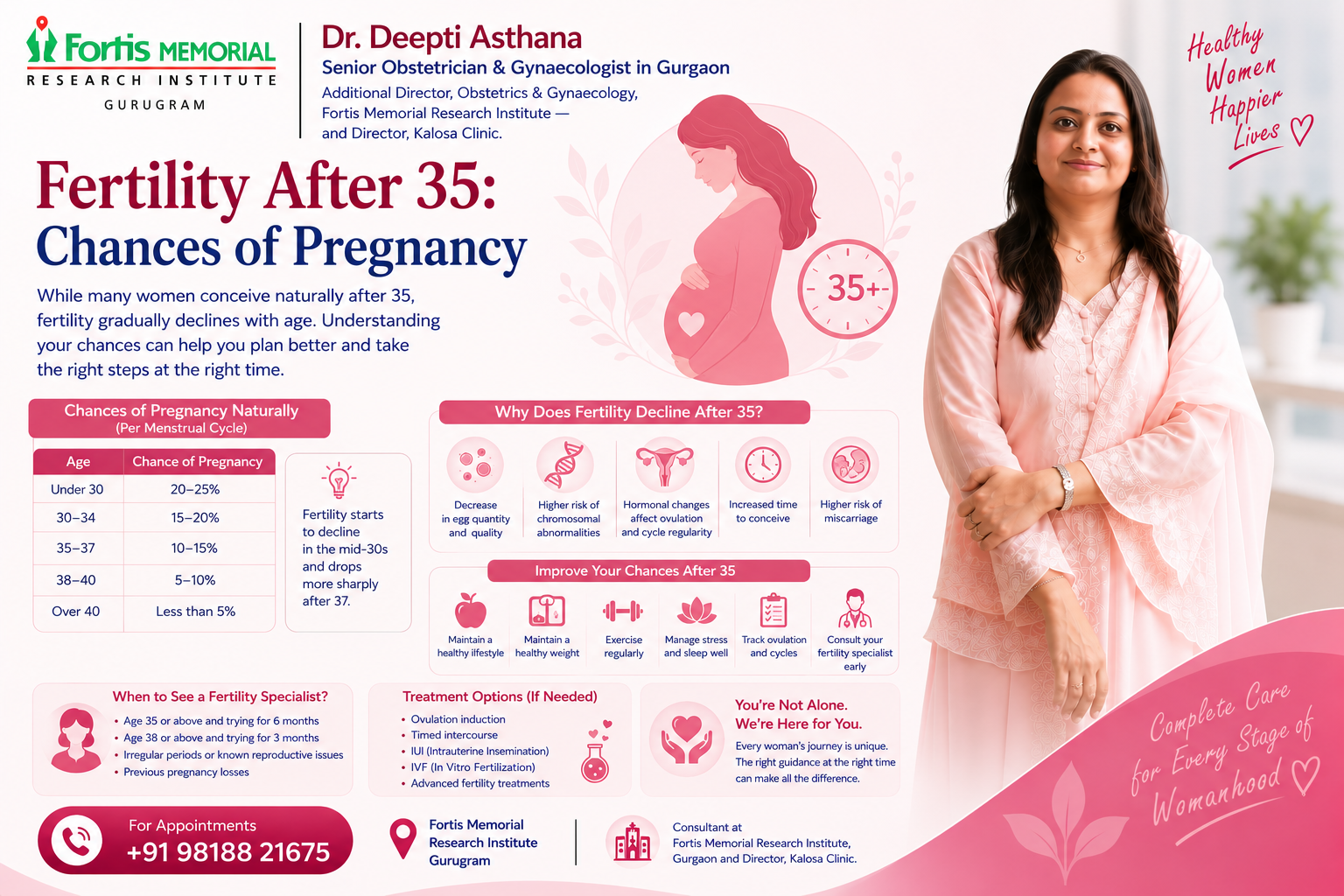
Pregnancy at 35 can raise a lot of questions. You might be thinking about whether you can conceive naturally, how long this may take or whether you should require fertility treatment. There are also other viewpoints you might hear from family, friends, and online.
The positive is that many women fall pregnant naturally at the age of late 30s and give birth to healthy babies. But, like any other process, fertility diminishes with age and becomes less likely the longer the years go by. Being aware of these changes can help you make informed decisions regarding pregnancy.
Let’s explore what happens to fertility after 35, what tests could help, and what you can do if you are planning a baby.
Fertility After 35: What Do the Numbers Say?
Several factors affect a woman’s ability to conceive, such as her age, ovulation, reproductive health and her partner’s sperm health. Ages are important because the number and quality of eggs produced is reduced with age.
A 2004 study of 782 couples attempting to become pregnant without the use of IVF was followed by the researchers of the Obstetrics & Gynecology study. It found that about 82% of women in the age group 35-39 became pregnant in the first 12 cycles. This means there’s still a lot of women in this category who are able to conceive naturally. However, it’s not like everyone has the same chance.
The chance of getting pregnant also wanes with each cycle as the age increases. According to the American College of Obstetricians & Gynecologists (ACOG), around 40 has a 10 percent chance of becoming pregnant each cycle, while a healthy couple in their 20s and early 30s has a 25 percent chance of getting pregnant in any given cycle.
Figures are indicative only and not forecasts of individual performance. This may be the case if you have certain health or reproductive factors.
What Happens To Fertility After 35?
Women are born with a limited number of eggs. As they get older the number degrades naturally and the remaining eggs are more likely to have problems with the chromosomes.
These modifications can have two effects on fertility:
Conception may take longer: The risk of the egg being fertilised and a healthy pregnancy developing decreases as the woman gets older.
There is a greater risk for pregnancy loss: Some eggs have chromosome abnormalities that stop the embryo from developing normally.
Age 35 doesn’t mean the end of fertility. The loss occurs slowly over time but may accelerate in the late 30s. In the early 40’s, natural conception may become more challenging. Age is not a factor. Other factors, like endometriosis, uterine fibroids, thyroid disorders, and ovulation issues can also impact a woman’s ability to get pregnant. Fertility in the male can also play a role in the rate of conception.
Is there a higher risk of miscarriage after age 35?
Yes. Maternal age is a risk factor for miscarriage, primarily because the risk of chromosome abnormalities increases with age.
This does not mean that a miscarriage will happen, though. Women who are over 35 can have successful pregnancies and healthy babies.
As the person gets older, there may be a greater risk of the following pregnancy issues:
- Gestational diabetes
- High blood pressure and pre-eclampsia.
- The state of the baby’s chromosomes
- Loss of pregnancy and stillbirths
These risks are dependent on age and personal health. They do not impact all pregnancies in the same way.
Regular antenatal visits may enable your doctor to keep track of your health and the development of your baby if you are pregnant after age 35. Your physician might also talk to you about prenatal screening and diagnostic tests to evaluate the risk of some chromosome conditions.
If you have a medical condition or have experience of pregnancy issues, early pregnancy care is especially helpful.
Why is 35 the magic age for fertility?
You’ve heard that fertility suddenly declines at 35. It’s a widespread misconception. No biological switch is turned on at the age of 35. Rather, the age of 35 is usually chosen as a clinical marker since age-related decline in fertility and pregnancy-related complications are more relevant at this time. Some women may find it easy to get pregnant at age 36. Others may have problems at an earlier age due to a medical condition. The key thing to remember is that fertility will vary from person to person and will also vary with age. You don’t need to panic, If you’re thinking about becoming pregnant in your 30s. However, becoming familiar with your choices is crucial.
What's the difference between Egg Quality and Egg Quantity?
There is a relationship between egg quality and egg quantity, but they are two different things.
What Is Egg Quantity?
Egg quantity is the number of eggs you have left in your ovaries. This is also known as your ovarian reserve. Egg reserves in women naturally get depleted with age. Women have different levels of ovarian reserve. AMH and antral follicle count are tests that can help doctors estimate the amount of ovarian reserve. These tests, however, can not identify every egg that is still present or determine exactly when you should try to conceive.
What is Egg Quality?
Egg quality is a measure of an egg’s ability to be fertilised and to develop a healthy embryo. Eggs from older women are at higher risk of chromosomal abnormalities. This can make it less likely for the pregnancy to proceed and can raise the risk of miscarriage. Egg quality can’t be measured directly with a routine blood test, unlike the egg numbers. While age is a good indicator of the risk of chromosome abnormalities, it does not indicate the risk for a specific egg or pregnancy.
Is it possible to naturally enhance egg quality?
Eating a healthy diet, exercising regularly, getting plenty of rest and avoiding smoking can also help maintain good reproductive health. It is also crucial to control medical conditions prior to becoming pregnant.
But no diet, supplement or lifestyle program has been proven to reverse the changes in egg chromosomes that occur with age. This difference needs to be recognized before the consumer invests in products that claim to enhance egg quality.
What Does an AMH Test Tell You?
AMH is also known as an anti-Müllerian hormone. It is formed in the small growing follicles of the ovaries where immature eggs are present. AMH is used in a blood test to help doctors determine ovarian reserve. It can also be used to predict the response of the ovary to fertility medicines during treatment like IVF.
Egg quality is not directly assessed by AMH, however, and it cannot accurately predict the ability to conceive naturally. Having a low AMH does not imply infertility. A normal or elevated AMH also does not necessarily mean pregnancy. Your doctor may use your AMH level, age, ultrasound measurements, and other lab tests to determine how to interpret your AMH level. If you have trouble conceiving, the fertility of your partner should also be assessed.
After 35, what can you do to improve your chances of conceiving?
There is nothing you can do to prevent your ovaries from aging naturally. There are, however, simple things to do before you become pregnant and to use to improve the timing of intercourse to help your health.
- Eat a Balanced Diet
Consume a wide range of fruits and vegetables, whole grains, pulses, nuts and protein rich foods to help maintain general reproductive wellbeing.
- Start taking Folic Acid before getting pregnant.
Consume 400 micrograms of folic acid daily at least 1 month before pregnancy, unless otherwise advised by your doctor.
- Keep a healthy weight and being active.
To support reproductive health and ovulation, keep a healthy weight, eat a balanced diet and exercise regularly.
- Get Adequate sleep and Stress Management
Ensure enough rest and use relaxation exercises for emotional health during pregnancy planning.
- Track Your Ovulation
Monitor your fertile window and engage in sexual intercourse one or two days a week during this time.
- Don’t smoke and don’t use harmful substances.
Avoid smoking and recreational drugs, avoid alcohol while trying to conceive, and discuss caffeine intake and regular medicines with your doctor.
When is it time to see a Fertility Specialist?
If you are 35 or more and trying for a baby, it is important to understand when to seek medical advice.
A fertility evaluation is advised in the following cases:
- Under the age of 35: If you are under the age of 35 and have been trying to conceive for 12 months without success, you should see a specialist.
- 35 to 40 years: If you have been conceiving for six months and have not succeeded, seek an evaluation.
- More than 40 years: See a fertility specialist immediately, preferably prior to attempting to conceive.
If you experience irregular or missing periods, a history of endometriosis, previous pelvic surgery or a medical condition that could impact fertility, you should seek advice sooner.
A fertility evaluation does not automatically mean that you will need to have IVF. It can assist your doctor in understanding what could be causing your fertility issues and what treatment options may be available to you.
What to expect at a fertility evaluation?
Depending on the history of your medical issues, your doctor may suggest any of the following tests:
Medical history: Your doctor will ask you about your menstrual cycle, the number of times you’ve been pregnant, if you have any medical conditions and how long you’ve been trying to conceive.
Blood tests: These may involve testing your hormones or thyroid, depending on your symptoms and medical history.
Pelvic Ultrasound: This will help to evaluate the uterus, the number of antral follicles, and the number of ovaries.
Fallopian tube assessment: An examination may be performed to determine if the fallopian tubes are open, for example, hysterosalpingogram (HSG).
Semen analysis: If you have a male partner, testing his sperm count and movement can help determine if there is a fertility problem.
Not all tests are necessary for all. Your doctor will pick the tests appropriate to your needs.
What choices are there for fertility after 35 in India?
Treatment will vary depending on your age, test results, reproductive health and the length of your time trying for a baby. Not all women require fertility treatment and IVF is not necessarily the first option.
Natural Conception
If your periods are regular, and fertility isn’t a serious issue, your doctor may recommend continuing to attempt a pregnancy naturally for a suitable time.
But, with the decrease in fertility rates as age goes up, it is essential not to postpone evaluation beyond the recommended time period.
Fertility Medicines
Medicines may help women who have problems with ovulation. The medicine to be used will depend on the cause of the problem. Medications should be used with a physician’s supervision.
Intrauterine Insemination (IUI)
IUI is a procedure in which eggs are prepared and then inserted into the uterus near the time of ovulation. It may be considered in specific circumstances depending on sperm quality, fallopian tube condition and woman’s age.
It should be discussed with a fertility specialist to determine its suitability and the chances of success.
In Vitro Fertilisation (IVF)
IVF is the collection of eggs from the ovary and their fertilisation in the laboratory. A transfer of the embryo into the uterus can then be performed.
IVF can be used when there are issues such as blocked fallopian tubes, other sperm problems, or failure to succeed with other treatments.
The success of IVF treatment depends on age because the eggs of women decrease in quality as they get older.
Egg Freezing
Egg Freezing can be considered for women who would like to have children down the road, but not at this time, so it may be worth talking to a fertility specialist about.
The eggs are collected and frozen for possible use later. What is important is their age at the time of freezing as younger eggs have a higher chance of giving rise to healthy embryos.
But egg freezing does not mean that a person will be able to have a pregnancy. Collection of eggs, egg quality, age at freezing and success of future treatment all have an effect on the result.
A specialist will be able to explain if egg freezing is right for you.
EXCELLENTTrustindex verifies that the original source of the review is Google. I had a wonderful experience with Dr. Deepti Asthana throughout my pregnancy. She was extremely supportive, patient, and approachable at every step. She always listened to my concerns carefully and explained everything clearly, which gave me a lot of confidence and peace of mind. I truly appreciate the care, guidance, and personal attention I received throughout my pregnancy and delivery. I felt completely comfortable and well taken care of under her supervision. I would highly recommend her to anyone looking for a knowledgeable, compassionate, and trustworthy gynaecologist. Thank you so much, Doctor Deepti Asthana, for being such an important part of this beautiful journey!Posted on GoogleTrustindex verifies that the original source of the review is Google. I have been consulting Dr. Deepti since the past 3 years. Starting as my gynaecologist, treating my PMOS to guiding me into motherhood and finally, being my Obstetrician to deliver my twin babies via C-section. She have been an unwavering support throughout the journey, and all this couldn't have been possible without her. She has a very professional, knowledgeable, non-judgmental and empathetic approach towards all her patients, and makes you feel comfortable and heard. I can definitely recommend her to others with my eyes closed.Posted on GoogleTrustindex verifies that the original source of the review is Google. Dr Deepti Asthana is a wonderful doctor and I feel really fortunate to have found her. She has a pleasant, positive and reassuring manner. She listened to my concerns as a patient and factored them in her treatment plan. My surgery went off seamlessly and the recovery is also very good. Her coordinator Rhea was also very helpful.Posted on GoogleTrustindex verifies that the original source of the review is Google. Dr. Deepti is an absolute blessing! What stands out most about her—besides her incredible expertise—is her unmatched patience and dedication. No matter when I reached out, she was always available to guide and support me, responding promptly and offering reassurance at every step. She listens attentively to every concern and never makes you feel rushed. Having a doctor who is both exceptionally skilled and so reliably accessible gives immense peace of mind.Posted on GoogleTrustindex verifies that the original source of the review is Google. I have been consulting Dr. Deepti Asthana for the last 2.5 years, and I am truly grateful to have found such a wonderful doctor. From my two surgeries, including my endometriotic cyst surgery, to my entire pregnancy journey and finally bringing my baby safely into this world, she supported me at every step. She always takes the time to explain everything clearly and patiently, which gave me a lot of confidence and peace of mind. She is very humble, caring, and trustworthy. Thank you, Dr. Deepti, for all your care, guidance, and support throughout my journey. A special thank you for safely bringing my baby into this world. I will always be grateful for everything. I highly recommend Dr. Deepti Asthana to anyone looking for a caring and experienced gynaecologist 🫰🏼🫰🏼Posted on GoogleTrustindex verifies that the original source of the review is Google. I am extremely grateful to Dr. Deepti Asthana for her outstanding care and support throughout my high-risk pregnancy. From the very beginning, she closely monitored my condition and guided me with confidence, professionalism, and compassion. Her clear explanations, timely advice, and reassuring approach helped ease my anxiety and made me feel safe throughout the journey. What I appreciated most was her patience in addressing all my concerns and her genuine commitment to both my health and my baby's well-being. Thanks to her expertise and dedicated care, I had a positive pregnancy experience despite the challenges. I highly recommend Dr. Deepti Asthana to anyone looking for a skilled, caring, and trustworthy gynecologist.🌸Posted on GoogleTrustindex verifies that the original source of the review is Google. Special thanks to dr Deepti mam and her team …. Iam writing this to express my deepest gratitude for the care and treatment you provided ……….. Thank you for guiding me through one of the scariest moments of my life.. your confidence gave me strength ,and your care helped me heal faster than I imagined Once again thank you soo much mam ❤️🫰🏻Posted on GoogleTrustindex verifies that the original source of the review is Google. Dr Deepti Asthana is best when it comes to take care of her patients. She is always available, active and passionate about caring. We are thankful to her. 🙏🏽Verified by TrustindexTrustindex verified badge is the Universal Symbol of Trust. Only the greatest companies can get the verified badge who has a review score above 4.5, based on customer reviews over the past 12 months. Read more
FAQs
01Can you become pregnant after 35?
Yes, lots of women are able to have healthy pregnancies after 35. But there are certain pregnancy issues and miscarriage that are associated with age. Regular antenatal care, and, in some cases, pre-pregnancy counselling will enable your doctor to detect and deal with potential complications.
02Is there a sudden drop in fertility after 35?
No. Fertility slowly decreases with age and the decrease is usually more rapid in the late 30s. The age of 35 isn't a new stopping point for biology. The age of 35 is a significant clinical marker, not a clear-cut biological age.
03Do I need to take into account freezing eggs at 35?
If you are considering delaying pregnancy, you may be able to freeze your eggs. The potential benefits will vary based on your age, ovarian reserve and the amount of eggs that can be retrieved. It does not ensure the possibility of a future pregnancy, so consult with a fertility specialist about the possible benefits, costs and restrictions.
04Is it possible to conceive without the help of an IVF doctor?
Yes, it's still possible to conceive naturally if AMH is low. The test primarily estimates ovarian reserve, and does not measure egg quality. It is important to discuss the result with your doctor, taking into account your overall fertility assessment.
05How many months should I wait before getting medical help for conceiving?
If age 35+, seek advice from a fertility expert after six months of unsuccessful attempts. Seek advice earlier if you are over the age of 40 or you have a known condition that could cause fertility problems.
Written and Verified by:
Dr. Deepti Asthana
Dr. Deepti Asthana is a leading gynecologist and laparoscopic surgeon in Gurgaon, Delhi NCR, backed by over 20+ years of clinical excellence. Having treated more than 30,000 patients and successfully performed over 10,000 complex gynecological surgeries.
She is widely trusted for comprehensive women's healthcare. Dr. Deepti Asthana specializes in managing all major female health conditions, ranging from normal deliveries and high-risk Caesarean births to advanced minimally invasive procedures such as laparoscopic hysterectomy, laparoscopic endometriosis surgery, ovarian cyst removal, and uterine fibroid treatment.
Her patient-first philosophy, individualized treatment protocols, and expertise in modern surgical techniques make her a top choice Best Gynecologist in Gurgaon.


