

There may be several reasons for having a hysterectomy (uterus removal) surgery. Due to fibroids, heavy bleeding, endometriosis, prolapse, or cancer. But there is no single surgery that works best for every woman. The suitable uterus removal surgery option depends on health condition and uterus size.
If your doctor has advised you to remove the uterus, you may have a lot of questions. One of the first that is most likely to come to mind is, “Which surgery is best for removing the uterus?” The common surgical approaches are laparoscopic, vaginal, abdominal, and robotic-assisted surgery.
Dr. Deepti Asthana, senior gynaecologist and additional director of the obstetrics and gynaecology department at Fortis, Gurgaon. Uterus removal surgery is a big decision, and requires a consultation with a senior gynaecologist near you. In this blog, you get to know about hysterectomy and common questions about that.
What is Hysterectomy?
Removal of the uterus medically known as hysterectomy. Doctors may suggest it for problems like fibroids, heavy bleeding, endometriosis, prolapse or certain cancers.
However, removal of the uterus depends on the underlying condition. Hysterectomy can involve the removal of the cervix, fallopian tubes, and ovaries. Ovaries may not always require removal.
With the removal of the uterus, periods stop forever and pregnancy is no longer possible. But if the ovaries are intact, then they continue producing hormones.
Now, let’s look at the conditions under which the doctor recommends this surgery.
Why Do Doctors Advise Uterus Removal?
For many non-cancerous conditions, doctors may consider medicines or less-invasive treatments before recommending hysterectomy. Surgery may be advised when other treatments are unsuitable, ineffective, or when cancer is suspected or confirmed. This surgery may be recommended for the following reasons:
- Uterine Fibroids: Non-cancerous growth which might cause heavy bleeding and pain.
- Endometriosis: Lining of the uterus walls growing outside of the uterus causing extreme pain.
- Gynaecological Cancers: Tumors in uterus and cervix.
- Heavy Bleeding: Heavy periods can lead to anaemia and weakness.
- Uterine Prolapse: The uterus descends into or, in severe cases, protrudes through the vagina.
- Chronic Pelvic Pain: Constant pain, which cannot be relieved with medications.
Types of Uterus Removal Surgery:
Hysterectomy is commonly conducted in three different ways.
Total Hysterectomy: This involves removal of uterus and cervix.
Partial (Subtotal) Hysterectomy: This involves removal of the top portion of the uterus while the cervix remains.
Radical Hysterectomy: The uterus, cervix, top portion of the vagina, and surrounding tissues are all removed. This procedure is primarily performed for treating cancers.
Surgical Techniques for Uterus Removal & Its Benefits:
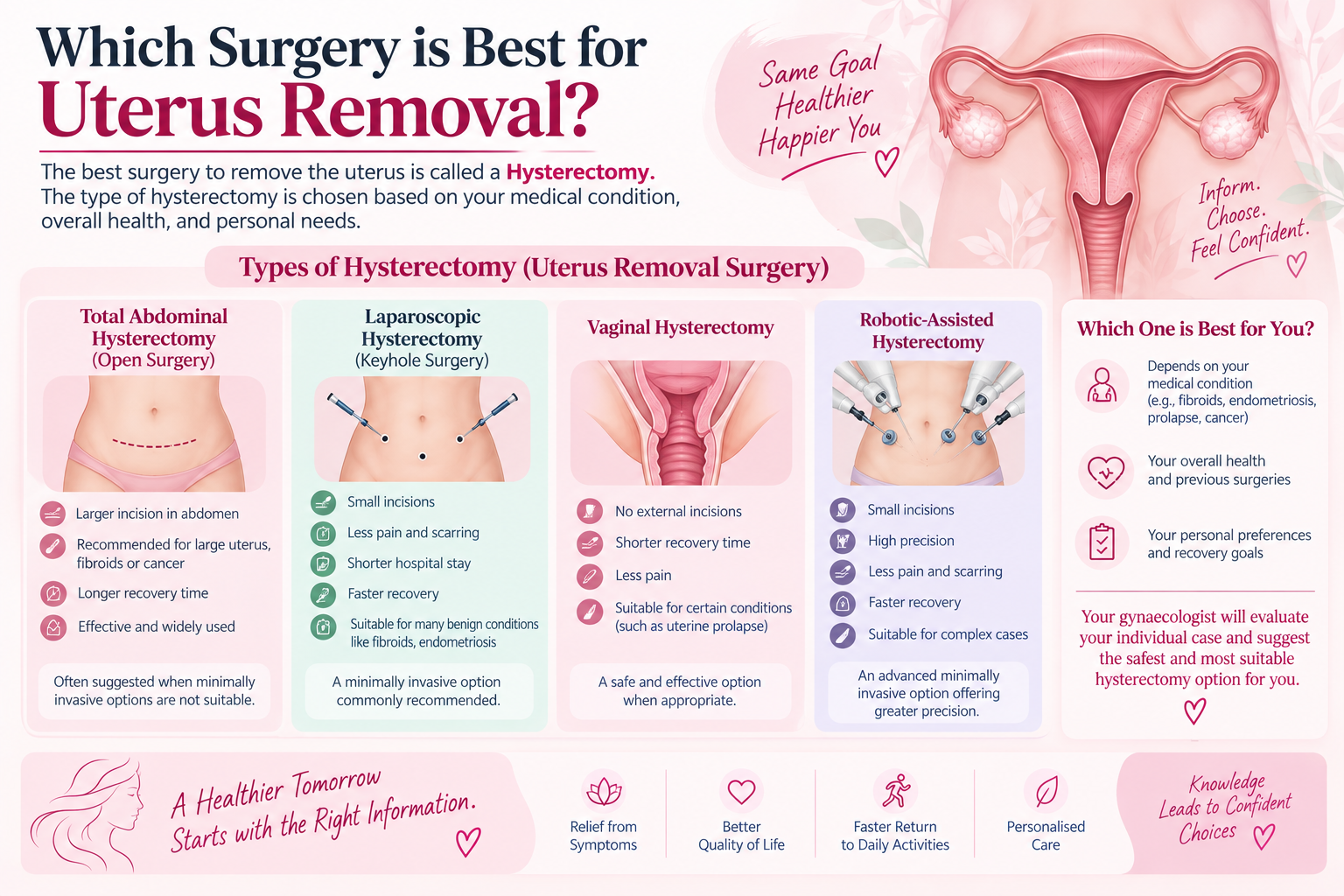
There are four main types of surgery that can be applied in addressing this problem. Each has different processes, risks, and recovery considerations.
Laparoscopic Hysterectomy (Keyhole Surgery):
This is currently the most popular choice across most major hospitals in India. The gynecologist makes 3 to 4 tiny keyhole punctures, less than a centimeter each, on your lower abdomen. A thin instrument called a laparoscope, as well as some other specialized surgical tools, are inserted into your body. The surgeon gets to see your organs clearly magnified on the screen and delicately detaches and withdraws the uterus from the body through these tiny cuts.
Key Benefits:
- Tiny, faint marks on the stomach that fade away over time.
- Very little blood loss during the procedure and low risk of stitch infection.
- Far less pain compared to traditional open surgery.
- Short hospital stay, most women go home in 1 to 2 days.
- Quick recovery, you can easily return to light household work in 2 to 3 weeks.
- Because of these clear advantages, keyhole surgery is suitable for most women, provided the womb is not unusually oversized.
Vaginal Hysterectomy:
In this procedure, the entire operation is performed through the natural vaginal opening. The surgeon does not make any cuts on the abdomen at all.
Key Benefits:
- Zero cuts or marks on your stomach.
- Fastest healing time among all available techniques.
- Very little discomfort after the operation.
- Lowest chance of wound infection or scarring issues.
- This method works wonderfully if your uterus is normal in size or if you are suffering from uterine prolapse. However, if you have very big fibroids or past surgical scars inside from previous operations, this path may not be possible.
Robotic-Assisted Hysterectomy:
This is a higher level of keyhole surgery. In this case, the surgeon operates at a special computer console inside an operation theatre and controls high precision robotic arms. The system gives a 3D, high-definition view of the inner body organs and allows easy movement in tight pelvic spaces.
Key Benefits:
- Very high accuracy around sensitive nerves and blood vessels.
- Minimal internal bleeding and rapid healing.
- Very useful in cases with severe endometriosis or in cases of extra weight to be carried.
- The technology is of high standard but the use of the high-tech hospital makes the whole process more costly than traditional laparoscopy.
Abdominal Hysterectomy (Traditional Open Surgery):
This is the traditional method. Here, the surgeon creates an incision along the lower abdomen that is horizontal. This cut is made at a length ranging from 4-6 inches, just as the one in the caesarean procedure. Using this incision, the doctor is able to reach the pelvis to remove the uterus.
Key Benefits:
- Gives the physician direct, unobstructed access to the whole pelvic region.
- It is an effective approach to treat large fibroids, large internal tumors, or if there is severe tissue sticking (adhesions) from previous surgery.
- Points to Consider: Leaves a permanent visible scar on the lower stomach.
You need to stay in the hospital for 3–5 days.
Increases pain and discomfort after surgery.
It will take approximately 6 to 8 weeks of proper rest for complete healing.
Comparing all four options side by side makes the differences clear at a glance.
So, How Do You Choose the Right Option?
The safest method is determined based on your health condition. Some considerations include:
- Uterus size: In case you have an unusually large uterus, an open surgery might be needed.
- Past surgeries: Previous history of Caesarean section or any surgery matters a lot in choosing the specific suitable approach.
- General health: Blood sugar, blood pressure and haemoglobin levels are checked before surgery.
Surgeon’s experience: Gynecologists with experience can help in choosing the most appropriate treatment. Similarly, just like selecting the right surgical procedure, proper post-surgery care is equally necessary for successful treatment.
Post-Surgery Home Care
After returning home, allow the body to recuperate. There are some simple precautions that can facilitate the recovery process:
- Rest: Do not pick up heavy objects or bend for too long for 4-6 weeks.
- Take a little walk: Begin with short, slow walks after consulting with your doctor. It may be beneficial for blood circulation and gas.
- Eat healthy food: Have simple home cooked meals; daal, fruits and vegetables. Have plenty of fluids and take fiber so as not to suffer from constipation.
- Prevent infection: Keep the wound clean and dry and take your doctor’s guidance regarding wound care.
- Take rest: Do not indulge in strenuous housework and sexual intercourse until your doctor advises you to do so.
Conclusion
Deciding whether to have a hysterectomy can be difficult. Vaginal, laparoscopic, robotic-assisted and abdominal procedures have different benefits, limitations and risks. Your gynaecologist will recommend an approach based on your diagnosis, anatomy, overall health and treatment goals. Ask about alternatives, expected recovery, possible complications and whether the ovaries or cervix need to be removed.
EXCELLENTTrustindex verifies that the original source of the review is Google. I had a wonderful experience with Dr. Deepti Asthana throughout my pregnancy. She was extremely supportive, patient, and approachable at every step. She always listened to my concerns carefully and explained everything clearly, which gave me a lot of confidence and peace of mind. I truly appreciate the care, guidance, and personal attention I received throughout my pregnancy and delivery. I felt completely comfortable and well taken care of under her supervision. I would highly recommend her to anyone looking for a knowledgeable, compassionate, and trustworthy gynaecologist. Thank you so much, Doctor Deepti Asthana, for being such an important part of this beautiful journey!Posted on GoogleTrustindex verifies that the original source of the review is Google. I have been consulting Dr. Deepti since the past 3 years. Starting as my gynaecologist, treating my PMOS to guiding me into motherhood and finally, being my Obstetrician to deliver my twin babies via C-section. She have been an unwavering support throughout the journey, and all this couldn't have been possible without her. She has a very professional, knowledgeable, non-judgmental and empathetic approach towards all her patients, and makes you feel comfortable and heard. I can definitely recommend her to others with my eyes closed.Posted on GoogleTrustindex verifies that the original source of the review is Google. Dr Deepti Asthana is a wonderful doctor and I feel really fortunate to have found her. She has a pleasant, positive and reassuring manner. She listened to my concerns as a patient and factored them in her treatment plan. My surgery went off seamlessly and the recovery is also very good. Her coordinator Rhea was also very helpful.Posted on GoogleTrustindex verifies that the original source of the review is Google. Dr. Deepti is an absolute blessing! What stands out most about her—besides her incredible expertise—is her unmatched patience and dedication. No matter when I reached out, she was always available to guide and support me, responding promptly and offering reassurance at every step. She listens attentively to every concern and never makes you feel rushed. Having a doctor who is both exceptionally skilled and so reliably accessible gives immense peace of mind.Posted on GoogleTrustindex verifies that the original source of the review is Google. I have been consulting Dr. Deepti Asthana for the last 2.5 years, and I am truly grateful to have found such a wonderful doctor. From my two surgeries, including my endometriotic cyst surgery, to my entire pregnancy journey and finally bringing my baby safely into this world, she supported me at every step. She always takes the time to explain everything clearly and patiently, which gave me a lot of confidence and peace of mind. She is very humble, caring, and trustworthy. Thank you, Dr. Deepti, for all your care, guidance, and support throughout my journey. A special thank you for safely bringing my baby into this world. I will always be grateful for everything. I highly recommend Dr. Deepti Asthana to anyone looking for a caring and experienced gynaecologist 🫰🏼🫰🏼Posted on GoogleTrustindex verifies that the original source of the review is Google. I am extremely grateful to Dr. Deepti Asthana for her outstanding care and support throughout my high-risk pregnancy. From the very beginning, she closely monitored my condition and guided me with confidence, professionalism, and compassion. Her clear explanations, timely advice, and reassuring approach helped ease my anxiety and made me feel safe throughout the journey. What I appreciated most was her patience in addressing all my concerns and her genuine commitment to both my health and my baby's well-being. Thanks to her expertise and dedicated care, I had a positive pregnancy experience despite the challenges. I highly recommend Dr. Deepti Asthana to anyone looking for a skilled, caring, and trustworthy gynecologist.🌸Posted on GoogleTrustindex verifies that the original source of the review is Google. Special thanks to dr Deepti mam and her team …. Iam writing this to express my deepest gratitude for the care and treatment you provided ……….. Thank you for guiding me through one of the scariest moments of my life.. your confidence gave me strength ,and your care helped me heal faster than I imagined Once again thank you soo much mam ❤️🫰🏻Posted on GoogleTrustindex verifies that the original source of the review is Google. Dr Deepti Asthana is best when it comes to take care of her patients. She is always available, active and passionate about caring. We are thankful to her. 🙏🏽Verified by TrustindexTrustindex verified badge is the Universal Symbol of Trust. Only the greatest companies can get the verified badge who has a review score above 4.5, based on customer reviews over the past 12 months. Read more
FAQs
1. In terms of recovery, which is the best option, open surgery or laparoscopy?
Laparoscopic surgery typically involves less pain and faster recovery due to smaller incisions. In more complicated cases and specially when the uterus is very large, an open procedure is advised. It takes longer to recover.
2. Will I put on weight following an uterus removal?
The removal of the uterus does not directly lead to weight gain. Less activity during recovery may lead to some temporary weight changes. A nutritious diet and brief strolls can help.
3. How many days do surgical patients require bed rest?
After laparoscopic or vaginal surgery, rest may be required for one or two days. Generally, you can walk right after, and resume to normal work according to the doctor’s advice and your recovery.
4. Is uterus removal operation risky?
Hysterectomy, like all other surgeries, poses some risk. However, this is a common type of surgery. The possible risks associated with the procedure will be determined by your physician depending upon your condition.
5. Does uterus removal lead to early menopause?
No. If your ovaries remain untouched, then hormone production will be continued by them. Early menopause is possible only in cases when both ovaries are removed.
Written and Verified by:

Dr. Deepti Asthana
Dr. Deepti Asthana is a highly distinguished Gynecologist, Obstetrician, and Laparoscopic Surgeon with extensive expertise in advanced minimally invasive surgeries and high-risk pregnancy management. With years of clinical excellence, she is dedicated to delivering evidence-based, compassionate care and empowering women through accurate health education.


